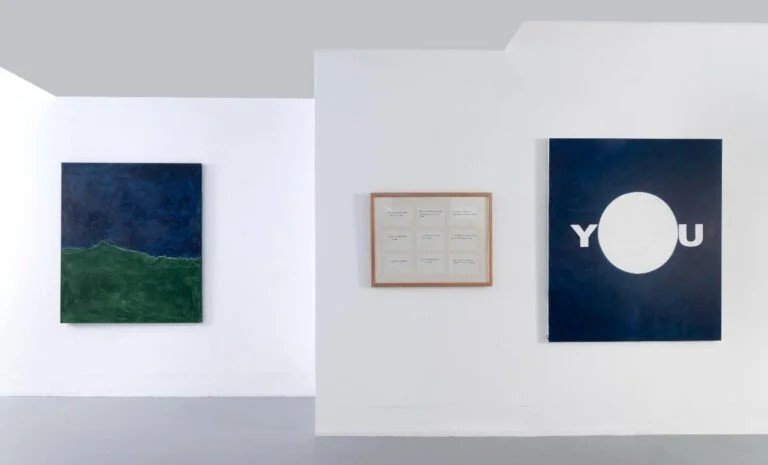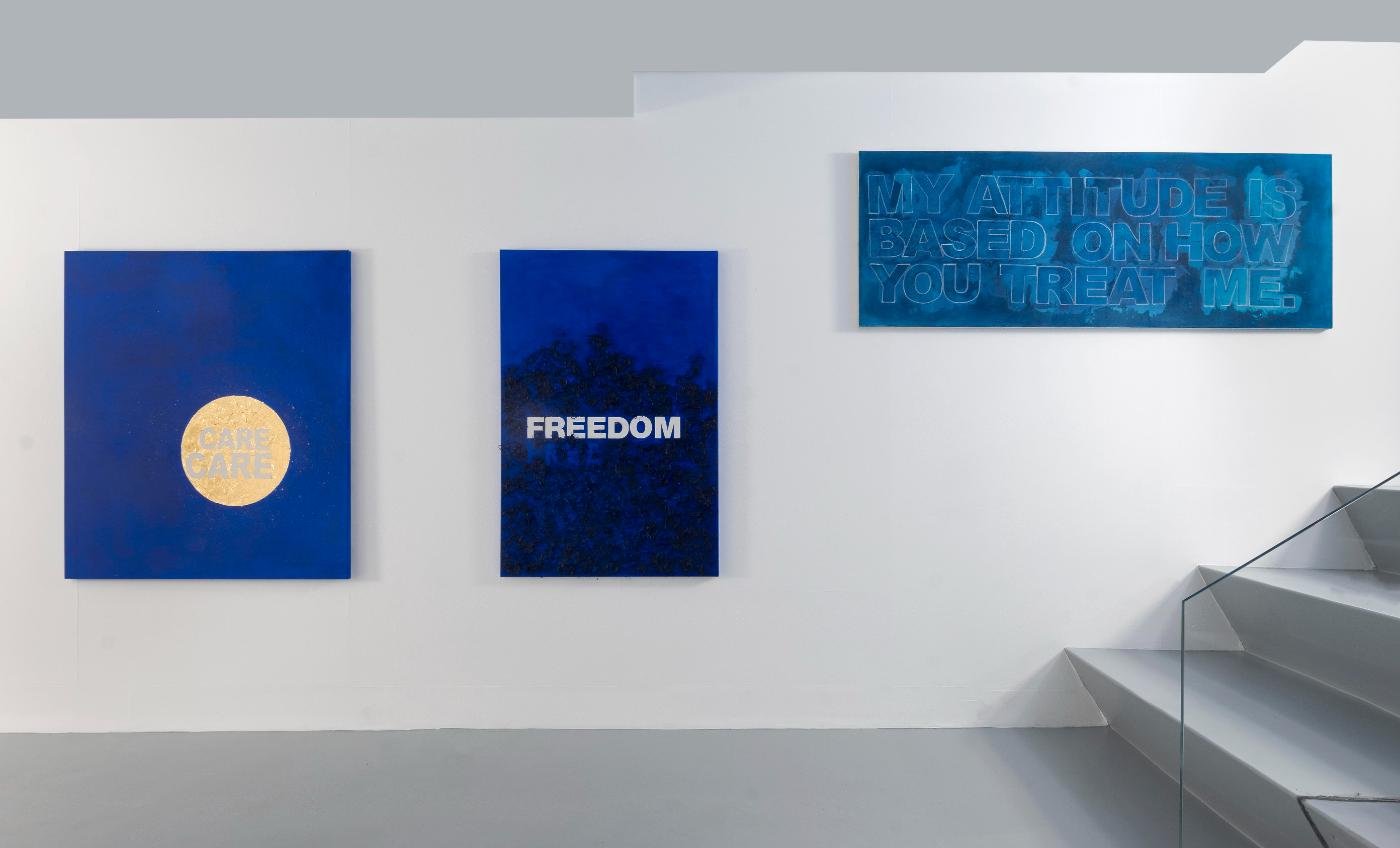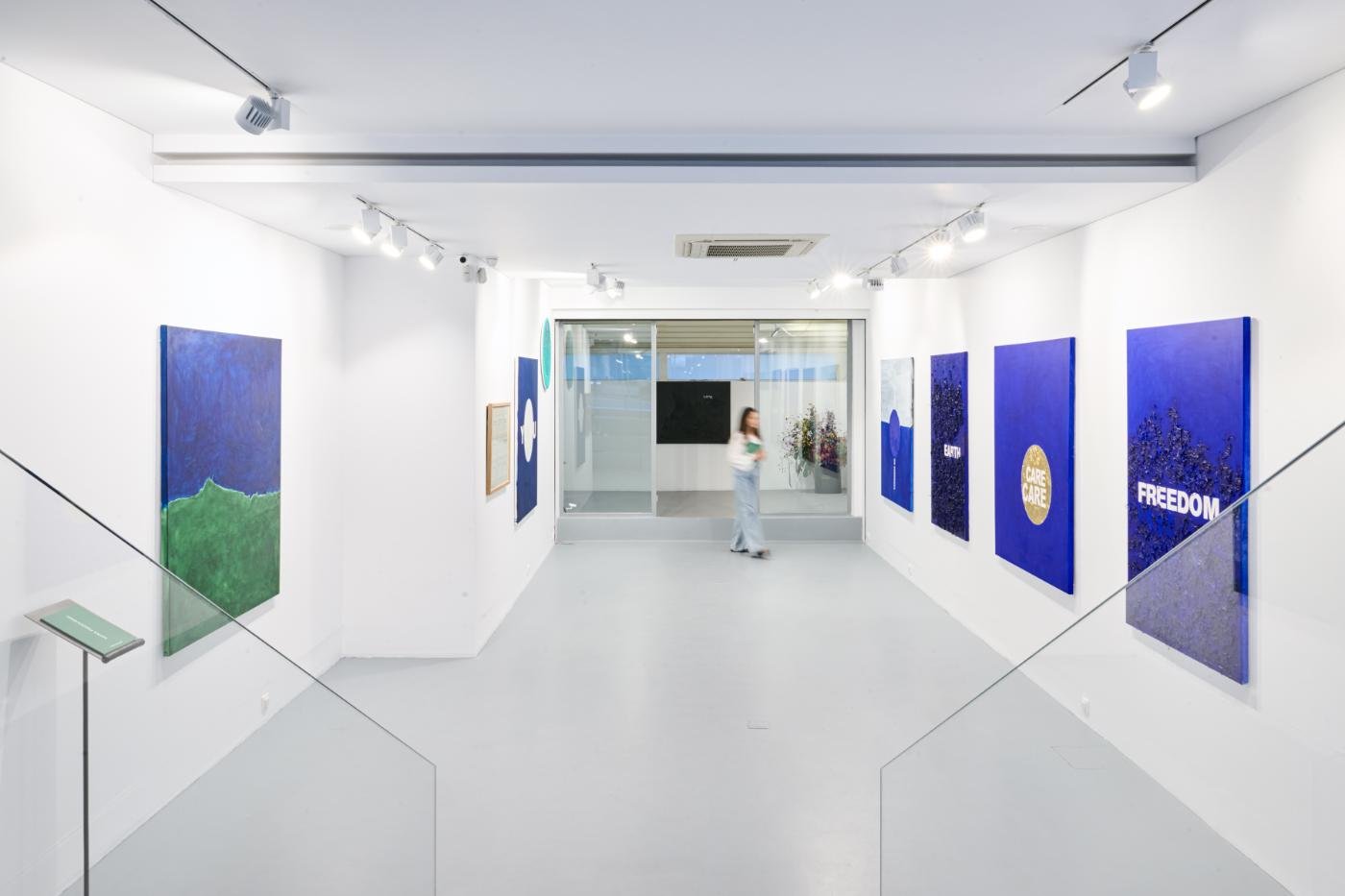
In YOU (2026), the word neither precedes the image nor functions as a slogan imposed from outside. The white O, enlarged to occupy the visual core of the canvas, interrupts the linearity of reading and turns the letter into a body. It remains part of the word, yet can also be read as a disc, a planet, an opening or an eye. Its form moves the viewer’s gaze between linguistic recognition and pictorial perception. This movement between reading and looking recurs throughout the exhibition. In Earth Care, EARTH almost recedes into the saturated blue and becomes legible only after a slight delay. In Care, the word is enclosed within a gold oval and acquires an emblematic presence. Language merges with graphic motifs and material surfaces, undergoing the same processes as colour and matter. It is covered, repeated or displaced until its legibility can no longer be taken for granted and the word gains formal autonomy. In Echo, REMEMBER ME is repeated in horizontal rows, forming an idiosyncratic typographic system. The blue disc cuts across the inscription, interrupting its legibility. YOU, REMEMBER ME, NO BLUE, NO GREEN, EARTH, STAND FREE, INSPIRE and CARE form a discontinuous syntax across separate works, their parts coming into relation as the viewer encounters the exhibition as a whole. A word can remain legible while also functioning as a line, contour, weight or interval. In The Earth Said, the phrase MY ATTITUDE IS BASED ON HOW YOU TREAT ME spans almost the full horizontal extent of the painted surface. It shifts the Earth from an object of environmental concern to a speaking subject that addresses the viewer. Read alongside the imperatives elsewhere, this second-person address makes the viewer its addressee.
The planetary scale suggested by YOU comes into sharper focus alongside NASA’s Artemis II mission and the images recorded during its flight around the Moon in April 2026. Fragoudaki followed these images closely, particularly those showing Earth as a distant body in darkness. Seen from afar, Earth, usually taken for granted as the setting of human experience, appears as a celestial body within a vastly larger field. Such a view has precedents in the photographs Earthrise (1968) and Blue Marble (1972), both associated with a less anthropocentric conception of the planet and a shift in scale from the human to the planetary and, ultimately, the cosmic. Fragoudaki does not seek a literal transcription of scientific imagery. Instead, she isolates its familiar diagrammatic logic and incorporates it into her painting. In Artemis II, two circular bodies are linked by fine curves suggesting orbital paths. The curves set the bodies in relation within an expansive blue field, lending the composition a diagrammatic structure. The cosmic distance heightens the sense of the planet’s materiality and fragility. As a finite celestial body, Earth challenges what might otherwise be taken as limitless or given.
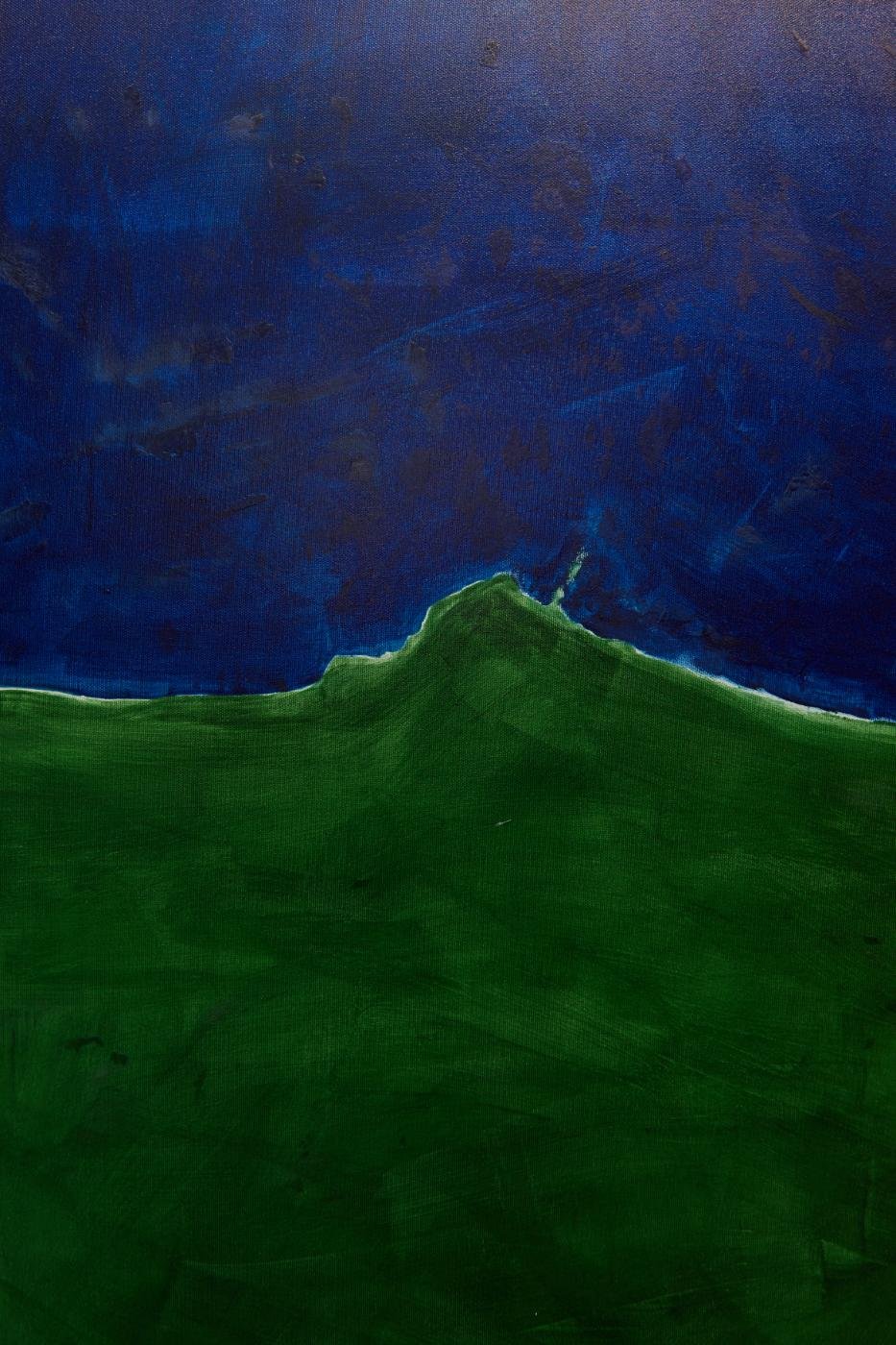
The return to the ocean extends this enquiry. The blue that links celestial and oceanic imagery also brings Fragoudaki’s work into relation with that of the oceanographer and marine biologist Sylvia Earle. A pioneer of deep-sea exploration, Earle founded Mission Blue in 2009, an organisation dedicated to exploring and protecting the ocean whose work centres on an international network of Hope Spots. Earle’s view that life on Earth depends on ocean systems finds concise expression in the phrase “No Blue, No Green”, which Fragoudaki incorporates into the titles of three works, in full or in abbreviated form. This ecological interdependence is rendered through the way blue and green share the surface: each defines the extent of the other and meets the materials set between them. In No Blue, No Green I and No Blue, No Green II, the two colours reverse positions. Dry pigment is combined with crushed gypsum in the first work and with glass collected on Leros in the second. These materials disrupt the homogeneity of the colour field. In the oil-and-acrylic painting No Blue, No Green, the composition centres on the phrase “NO BLUE / NO GREEN”. The white outline and small colourful discs interrupt the image’s geometric clarity, drawing attention to the boundaries between the colours. In Protecting the Blue, a deep blue core is bordered by a gold contour and a green ground, forming a concentric arrangement. Blue is not merely a symbol of the sea; in Fragoudaki’s new body of work, it has a specific density, saturation, transparency and visual weight. In Equilibrium, the interdependence of blue and green receives its clearest painterly expression. The two colours occupy broad fields whose density changes through successive layers, with traces of the painting process still visible. Where they meet, a narrow luminous band sharpens their boundary without fixing it. The blue deepens towards darkness and the green retains its earthy density. Held in a fragile balance, the composition gives pictorial form to the phrase “no blue, no green”.
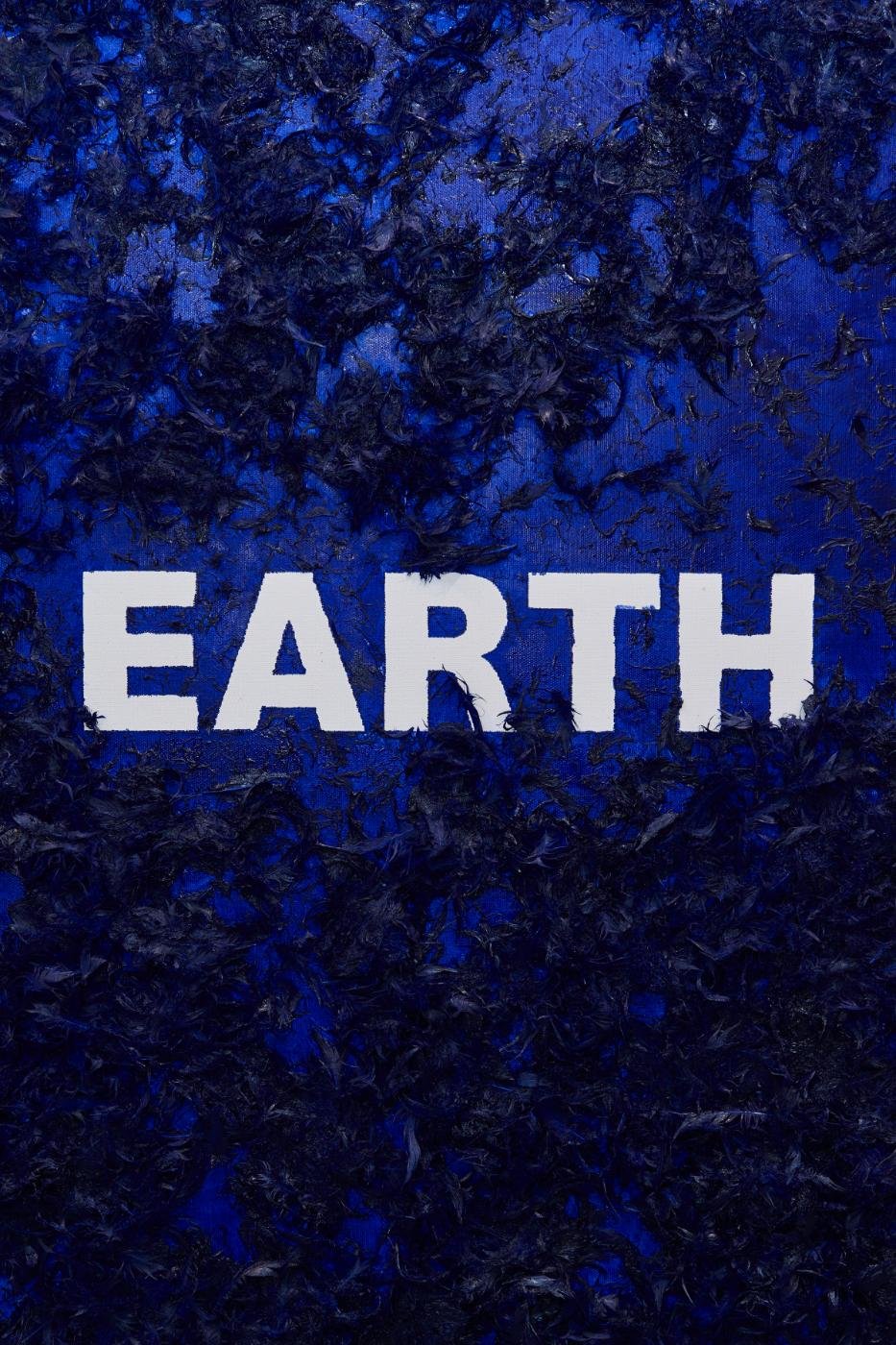
The need to care for marine ecosystems returns the discussion to an enduring concern in Fragoudaki’s practice, care. Developed after the birth of her third child, the Pumping Bags series (2022–2024) links motherhood to nourishment and to the interdependence of the maternal body and nature. In these works, care is bound to the body and the processes that sustain life. In the new works, care extends beyond the maternal relation to encompass human dependence on water, climate and diverse ecosystems. In Care, the repetition of the word within the gilded oval acquires symbolic weight. In Care (silk collage), the word appears as a small white handwritten inscription on the black field above the raised folds of silk. In Inspire Care, the imperative is outlined in blue against an almost monochrome ground. In Earth Stand Free, the inscription is incorporated into a recurring arrangement of circular forms. In Freedom and Earth Freedom, the language returns in emphatic lettering, though its position changes. In Freedom, the white lettering stretches horizontally above the dark feather relief, separating the dense lower section from the more open blue field. In Earth Freedom, EARTH sits lower, within the relief itself, more fully integrated with the feathers. The word remains legible in both works, but its function depends on its position and scale and on the contrast between the flat painted surface and the feather relief. Language retains its ethical charge, however its meaning also depends on the material and formal conditions of each work.
The circle recurs across the exhibition and has long featured in Fragoudaki’s practice. In the earlier Circles series, she created three-dimensional circular constructions from feathers, rubber, thread and other materials, drawing on an image of moonlight seen through the circle formed by treetops in a dark forest. In the present works, the circle takes on new associations as it forms the O in YOU, the gold enclosure in Care and the blue core in Protecting the Blue. In a 1930 letter to Will Grohmann[1], Wassily Kandinsky described the circle as balancing concentric and eccentric forces and as the primary form that points most clearly towards the fourth dimension. In Fragoudaki’s work, the circle retains its geometric autonomy while acquiring a specific ecological association through Earle and the emphatic statement “No Blue, No Green”.
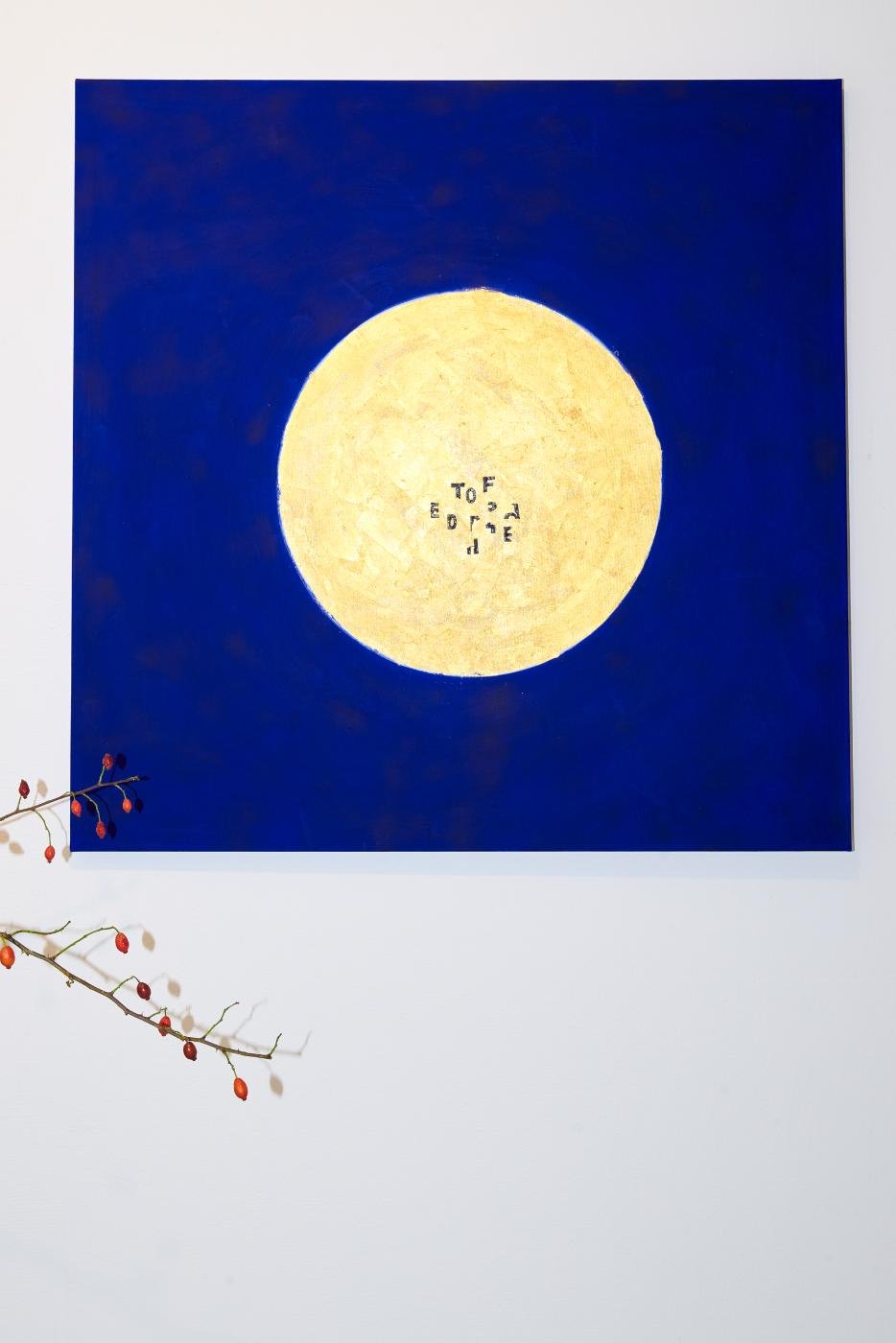
Transformation also extends to the materials themselves. Fragoudaki’s training in chemistry shapes the way she understands and handles them. Oil, acrylic, dry pigment, gypsum, glass, feathers, silk, PVC and gold leaf vary in absorption, opacity and reflectivity; some also introduce physical relief. Textured materials interrupt the canvas’s flatness and bring its physical surface to the fore. In Richard Pinčák and the Solution to the Black Hole Information Paradox, the work takes as its starting point the black-hole information paradox and, more specifically, the theoretical model proposed in 2026 by Richard Pinčák and his collaborators[2]. In this model, halting the final stage of evaporation leaves a stable remnant capable, within the model, of storing information. A gold disc dominates the deep blue field, with small fragments of text gathered within the disc so that information itself appears fragmented. The scientific problem is condensed into a specific question: what can persist when a state ceases to exist in its previous form?²
Across the exhibition, a limited vocabulary of forms, colours and materials shifts in function from one work to another. Circles, blue, words and fragments recur in altered scales, material states and meanings. Blue can suggest the ocean or cosmic depth without ceasing to be a colour, while the circle retains its geometry as a letter or a planet. A fragment of gypsum belongs to the material surface as much as to the image of a world. Painting brings legible language, the image’s referential force and the physical presence of materials together on the same surface. The imperatives extend care to the act of looking itself, directing the viewer’s attention to the relations between colours, the behaviour of materials and the fragility of the surface.
Alia Tsagkari
Art historian and curator
[1] Wassily Kandinsky to Will Grohmann, October 12, 1930, quoted in Will Grohmann, Wassily Kandinsky: Life and Work, trans. Norbert Guterman (New York: H. N. Abrams, 1958), 188.
[2] Richard Pinčák, Alexander Pigazzini, Michal Pudlák and Erik Bartoš, “Geometric Origin of a Stable Black Hole Remnant from Torsion in G₂-Manifold Geometry,” General Relativity and Gravitation 58 (2026), art. 29.